
The Lummi People, or Lhaq’temish (People of the Sea), have flourished in the coastal regions of the Pacific Northwest for over 12,000 years. Long before the establishment of modern borders, the Lummi lived as a maritime culture, deeply interconnected with the waters of the northern Puget Sound and the Gulf of Georgia.1 2
Ancestral Roots and Culture
The traditional society of the Lummi was built upon a profound spiritual and economic relationship with the Salmon. They were master fishers, utilizing a unique and sophisticated method known as reef netting. This technique involved suspended nets between two canoes to mimic the seafloor, allowing the community to harvest salmon sustainably while honoring the “First Salmon” through sacred ceremonies.
Their villages consisted of large, permanent longhouses made of Western Red Cedar, which served as the center for social life, potlatches, and oral storytelling. These longhouses were not just shelters but symbols of lineage and communal strength.
The Point Elliott Treaty of 1855
The mid-19th century brought significant upheaval as European-American settlers moved into the region. In 1855, the Lummi were one of the many tribes to sign the Treaty of Point Elliott. While the treaty ceded vast territories of their ancestral lands to the United States government, it crucially reserved their rights to hunt and fish in their “usual and accustomed grounds and stations.”
Following the treaty, many Lummi people were forced to relocate to the Lummi Indian Reservation on the peninsula west of Bellingham, Washington. Despite the pressures of forced assimilation and the boarding school era, the tribe fought tenaciously to preserve their language, Xwlemiʼchosen, and their traditional governance.
Sovereignty and Modern Resilience
The 20th century was marked by a legal and cultural renaissance. The landmark Boldt Decision (1974) reaffirmed the treaty rights of the Lummi and other tribes, upholding their right to 50% of the harvestable salmon. This victory allowed the Lummi Nation to become leaders in fisheries management and environmental stewardship.
Today, the Lummi Nation is a self-governing, sovereign nation and the third-largest tribal nation in Washington State. They remain “protectors of the Salish Sea,” balancing modern economic development—such as the Silver Reef Casino and the Lummi Bay Markets at the Cove and Exit 260 — with a fierce commitment to restoring the health of the salmon populations and the ecosystem that has sustained them since time immemorial.
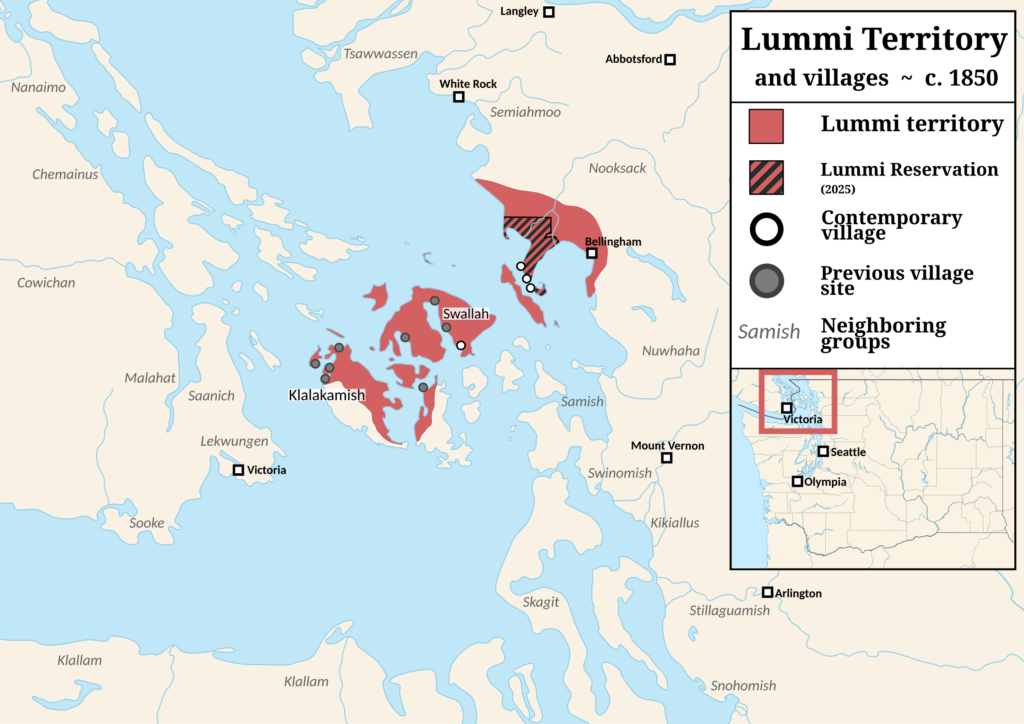
CC BY-SA 4.0
